
Health literacy in the age of AI
September 8, 2026
clarity is a shared responsibility
When someone is worried about their health and looking for answers, they are rarely encountering information under ideal conditions.
They may be anxious, overwhelmed or short on time. They may be trying to understand unfamiliar medical language, compare conflicting advice or navigate a health system they don’t know well. Increasingly, they may also be turning to digital tools, including AI, to help make sense of it all.
In that context, health literacy cannot simply be about whether an individual can understand the information available to them. It is also about whether the information, services and digital experiences around them are designed to be understood in the first place.
This International Literacy Day marks 60 years of global action to promote literacy, under the theme Literacy for People, the Planet and Prosperity, with a focus on literacy in the digital era. It also comes just days after the launch of Australia’s first National Health Literacy Framework.
For those of us working in health communications, this is a timely reminder of something we already know: the way we communicate can make it easier – or harder – for people to understand, engage with and act on information about their health.
Health literacy is everyone’s business
Health literacy has traditionally been framed as an individual’s ability to find, understand and use health information.
The new National Health Literacy Framework takes a broader, more human-centred view. It recognises that health literacy is shaped not only by people’s individual capabilities, but by the accessibility and design of the information, services and systems around them.
When information is overly technical, fragmented, difficult to find or disconnected from people’s real lives, the problem does not sit solely with the person trying to understand it.
Creating a more health-literate environment requires action across the system – from governments and health services to healthcare professionals, communicators, technology providers, community organisations and the media.
More information doesn’t always mean greater understanding
People have access to more health information than ever before. But more information has not necessarily made health decisions easier.
The Framework highlights the challenge: fewer than one in ten Australians report that they fully understand what they are reading online, while more than a quarter say they don’t have enough information to manage their health.
Meanwhile, the way people find and engage with information continues to evolve. People move between healthcare professionals, search engines, social media, online communities, apps and AI-generated answers – often encountering different language, advice and levels of evidence along the way.
The challenge is not simply whether someone can access health information. It is whether they can find it, understand it, assess it, trust it and use it to make an informed decision that works for their life.
Designing communication around people
When it comes to health communications, there are some key questions we can keep in mind. As well as thinking about the message we want to deliver, we can equally consider the person receiving it and the environment in which it’s being received. For example:
- Who are we trying to reach, and what matters to them?
- What could make this information difficult to find, understand or act on?
- How can we make complex information clearer without losing scientific accuracy?
- Is it accessible, culturally appropriate and inclusive?
- Where will people encounter it, and how might it be shared, summarised or interpreted?
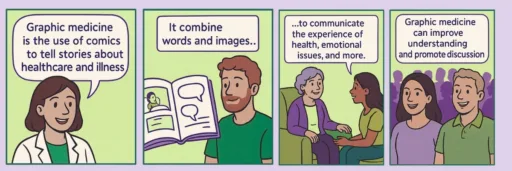
Sometimes the answer is clearer language. Sometimes it is visual storytelling, animation or graphic medicine. Sometimes it is a digital experience that makes it easier to find the right information at the right time. Or it’s a combination of these.
AI doesn’t change these fundamentals; if anything, today’s AI-powered world reinforces the importance of clear language, credible sources, evidence-based information, accessibility and context.
The question is no longer simply where our content will appear, it’s also how it might travel.
A shared vision for better health
Australia’s National Health Literacy Framework sets out a vision for better health and wellbeing for all people in Australia across the life course, with people and communities empowered and supported to access, understand and use health information and services to make informed decisions about their health.
Achieving that vision will require more than asking people to become better at navigating complexity. It requires all of us who create health information, services and systems to reduce that complexity wherever we can.
At Cube, this is a responsibility we embrace every day – working across communications for patients and the public, as well as healthcare professionals and expert stakeholders, to translate complex science into information that is clear, credible, accessible and human.
International Literacy Day, alongside Australia’s first National Health Literacy Framework, gives us a useful moment to reflect on that shared responsibility – and the role we all have in creating a healthier, more health-literate Australia.
Are you interested in making your health communications clearer, more accessible and more effective?
Health literacy FAQs
What is health literacy?
Health literacy is the ability to find, understand and use health information and services to make informed health decisions.
Why is health literacy important?
Health literacy helps people understand health information, navigate services and make informed decisions about their health.
Who is responsible for health literacy?
Health literacy is a shared responsibility between individuals, healthcare organisations, communicators and the broader health system.
What is organisational health literacy?
It is how well an organisation makes its health information and services easy to find, understand and use.
How can healthcare organisations improve health literacy?
Use clear language, accessible formats, intuitive information design and communications developed around audience needs.
Is health literacy the same as plain language?
No health literacy is not the same as plain language. Plain language supports health literacy, but accessibility, format, navigation, context and channel also matter.
How does AI affect health literacy?
AI is changing how people find and interpret health information, making clear, credible and accessible source information increasingly important.
How can healthcare communicators support health literacy?
By making credible health information easier to find, understand and use across different audiences, formats and channels.

Author
Annabel Longden
Annabel is a Senior Digital Account Manager at Cube, with five years' experience leading digital health communications and campaigns across oncology, ophthalmology and autoimmune conditions. She specialises in translating complex healthcare messaging into compliant, engaging digital strategies for patients, healthcare professionals and corporate stakeholders, spanning disease awareness campaigns, product launches and corporate communications. With a background in Biology, Annabel combines data-driven strategy with authentic patient advocacy, including several years advising the National Rheumatoid Arthritis Society (UK) on communicating with young people living with arthritis.

